
Changing Face of Battlefield Comms: Data-Heavy, Multi-domain, Rapid Movement and Automated
In military operations where downtime isn’t an option, network resilience has become a threshold requirement rather than an objective. Reliable communication on wireless networks is required for efficient Command and Control (C2) during deployment, where milli-seconds are critical. In complex and mobile environments that battlefields face, gaps often emerge. When evaluating these challenging environments, key considerations typically include data-heavy, low-latency, multi-domain, and constant-movement, all of which impact how communications transfer across battlefields. Rajant provides real-time range and modularity to maintain continuous wireless communications as mission objectives shift and rugged conditions evolve across rugged terrain.
With the recent exponential growth of automated systems in combat applications, reliable communications at scale only adds to the complexity of the issue.
To help us navigate these challenges and understand how InstaMesh’s self-healing technology ensures resilience, Ed Preston, President of Military and Government Markets at Rajant Corporation, shares his insights. Drawing on his extensive background in automation and operational deployments, Ed explains why scalable, self-optimizing networks are an essential asset for modern defense.
Limitations of Satellite Communications and Centralized Networks
Many traditional network solutions are designed for environments where command post infrastructure is fixed and operational conditions remain stable. Satellite Communications (SATCOM) are an integral part of today’s battlefield and provide a critical link to beyond line-of-sight (BLOS) networks. In more complex or dynamic settings such as mobile battlefields, these approaches may face limitations related to network availability, electronic warfare, and adaptability to automated systems.
Because of these limitations, satellite communications have been limited to voice or Intelligence, Surveillance and Reconnaissance (ISR) missions. Recent changes to operational doctrine call for the execution of Multidomain (Land, Air, Sea, Space, Cyber) Large Scale Combat Operations (LCSO) which require integration and coordination of dispersed assets and must also facilitate the use of automation.
Dependency on centralized computing systems can be rigid in environments where data processing and real-time information is critical. Mesh networks are a key enabler of decentralized computing which allows for rapid and automated decision-making at the edge, via a low-latency data mesh.
What Makes Mesh Networks – Especially Private Mobile Mesh – Better Suited for Modern Defense
In defense operations, communication requirements are often shaped by mobility and challenging operating conditions, demanding reliable wireless communication in environments that are dynamic, and unpredictable. Traditional network architectures can struggle to adapt to these factors, particularly when wireless communication is intermittent, infrastructure is limited, or the network topology changes frequently. Mesh networking offers an alternative approach by enabling devices to communicate directly with each other and dynamically route data across the network, helping organizations in defense maintain more resilient, secure, stable and mobile communications as operations evolve.
Kinetic Mesh uses network redundancy to maintain multiple reliable communications paths with other assets, especially in complex environments where there is frequent mobility on the field. By incorporating multiple nodes onto mobile (i.e. personnel, ground vehicle, aircraft, UAS, UGV, etc.) and/or static assets (i.e. fixed command posts), this will create multiple paths and ensure that mission-critical decisions are able to take effect, even when connections and devices are disrupted by interference. This creates a range for the network to operate under – allowing for persistent reach under mobility, interference, and degradation.
Decentralization is a key difference for mesh networks, as nodes communicate with each other rather than rely on a central device. Routing decisions are made at each node based on the source and destination of each data packet combined with real-time network performance metrics to identify the throughput/latency optimized path.
By utilizing Rajant’s InstaMesh technology, this ensures if one BreadCrumb goes down or becomes degraded, packets will automatically reroute to the best active network node. InstaMesh allows the Kinetic Mesh network to become modular – being able to reshape the network in real-time without any compromise to any current processes on the network.
Role in Broader Defense-Tech Ecosystems (Drones, C2, Sensors)
Autonomy in defense operations can be expanded by utilizing enabling capabilities such as Rajant’s mesh network which goes beyond traditional wireless communication to support teleoperation and autonomous systems. This expansion enables organizations to move from basic one-to-one operator/system connectivity and control toward more advanced, one-to-many data-driven control and utilizing automation in real-time/safety-critical applications. Rajant mesh enables these applications with low-latency data, resilient multi-hop wireless communication, and distributed computing at tactical edge, all of which help support responsive control, autonomous decision-making, and continued operation in dynamic or contested environments.
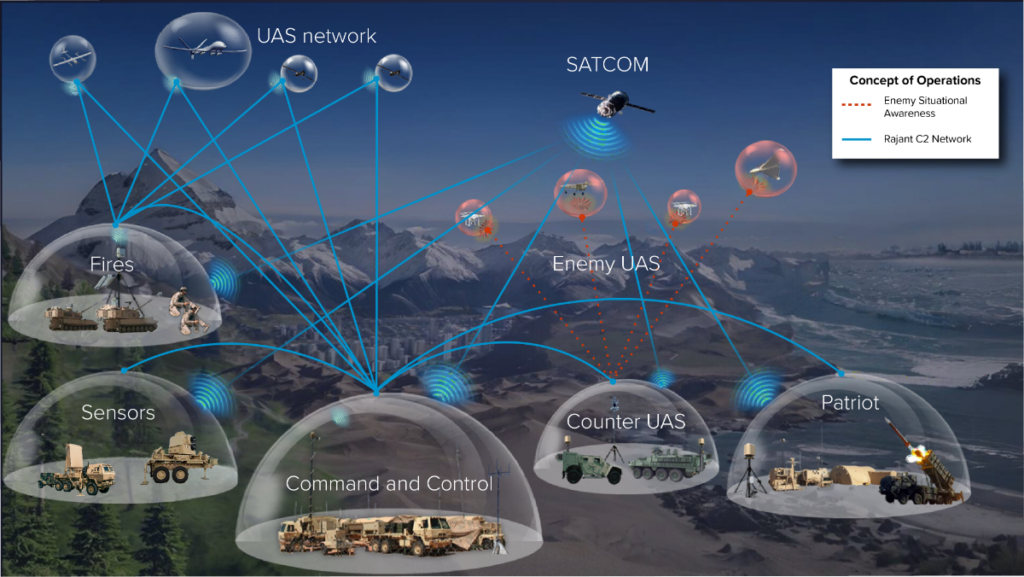
Rajant Mesh also can integrate into existing C2 systems which also enables an any sensor/any shooter decentralized weapon-target assignment approach to missions such as Integrated Air and Missile Defense (IAMD).
In this construct, as shown in Figure 1, the Rajant Kinetic Mesh network will automatically measure, calculate and utilize the optimized data path from sensor to C2 to shooter. Enemy UAS are detected by local Counter UAS sensors with track data being transmitted to the C2 node via direct LOS RF, aerial BLOS RF relay, or SATCOM depending on the lowest-latency path available. C2 can utilize relevant (not stale) track data to confirm and classify the enemy threat.
In preparation for engagement, C2 will nominate the based on factors such as probability of kill, resource allocation and minimization of friendly attrition based on near real-time data. When authorized, nominated assets are then able to engage the enemy threat. Throughout this thread all sensors, C2 and effector assets are able to utilize any available link in the unified multi-domain/multi-mode enabled by Rajant’s Software Defined Network capability with no operator actions required. The result is a continuously throughput and latency optimized network, on the ground, in the air or in space.
Conclusion: Mesh as Foundational Infrastructure for Future Military Comms
Mesh networking has become a mission-enabler by providing resilient, adaptive wireless communication in heavy-duty environments such as military operations, where traditional networks struggle to operate. By supporting mobility, redundancy, and distributed communication, mesh architectures help ensure that systems, personnel, and autonomous assets remain connected even as conditions change. Rajant provides range and modularity where they matter most at the network level, enabling continuous communications on the battlefield as objectives, terrain, and spectrum conditions evolve.
To stay connected on developments related to Rajant’s intelligent edge solutions, connect with Ed on LinkedIn. Explore how mesh networking supports edge computing, autonomy, and next-generation military systems by contacting a Rajant representative through our contact page.
