
Technology
Operational Networking Infrastructure
Distributed military operations depend on the ability to connect autonomous platforms, drones, sensors, and edge computing systems operating across dynamic and contested environments. Rajant provides operational networking infrastructure designed for distributed systems. Our technology enables drones, robotic platforms, sensors, and mission applications to operate together as a resilient, self-healing network that adapts as systems move and conditions change. Rather than replacing existing communications systems, Rajant integrates with radios, satellite links, and other transports to create a unified networking layer that allows distributed systems to operate as a coordinated mission capability.
“The future of military networking isn’t about replacing radios – it’s about unifying every transport into a single adaptive mesh at the forward edge.”
Rajant provides the infrastructure required for distributed operations to connect, scale, and operate in contested environments.
Adaptive Networking Infrastructure for Distributed Operations
Rajant networking infrastructure enables distributed platforms, sensors, and communication systems to operate together as a unified operational network.
Instead of relying on fixed infrastructure or centralized control, Rajant Kinetic Mesh® networking allows every node in the network to dynamically evaluate available communication paths and select the best route for each data packet in real time.
This architecture enables communications to persist as platforms move, environments change, or links are disrupted.
The result is a network that adapts continuously to the operational environment while maintaining reliable connectivity for distributed systems.

Unifying the Distributed Network
Rajant Kinetic Mesh® networking provides the distributed connectivity foundation that enables mobile platforms, autonomous systems, and edge computing environments to operate together reliably in the field.
Fielded in real operational environments, Rajant Kinetic Mesh technology enables continuous connectivity that supports situational awareness for personnel, platforms, and sensors across distributed environments. Each node learns and constantly reevaluates the best link available for each destination in real time by analyzing every packet moving through the network.
This adaptive behavior allows communications paths to evolve dynamically as platforms move, environments change, or network conditions shift.
Rajant Kinetic Mesh strengthens defense operations by enabling resilient communications and reliable data, video, and sensor connectivity even in RF-congested or contested environments.
Rajant’s Mesh.Over.Everything™ networking fabric extends mesh principles beyond homogeneous radio networks, allowing multiple communication systems to function together as a unified operational network.

Connecting the Communications Ecosystem
Modern mission environments depend on a growing number of communications systems operating simultaneously. Radios, satellite links, wireless networks, and emerging platforms must all exchange data reliably.
Rajant Instamesh™ technology enables high-speed integration across these diverse systems without requiring existing architectures to be replaced.
Rather than replacing radios, satellites, or networks, Instamesh connects them. Data moves intelligently across all available paths, dynamically selecting the best route as conditions change.
This capability allows communications to persist despite uncertainty, mobility, and disruption.
Mesh.Over.Everything represents a networking approach built on diversity, resilience, and movement rather than reliance on a single transport or communication domain.
The result is a network that adapts to the mission environment rather than forcing the mission to adapt to the network.

Security at the Forward Edge
At the Forward Edge, security must move with the mission rather than rely on fixed perimeters.
Rajant Kinetic Mesh is designed to operate with NSA Type 1 capable and FIPS 140-3 validated cryptographic solutions, enabling secure communications across manned and unmanned platforms operating in contested environments.
Encryption, authentication, and key protection are enforced at the node level. As the network moves, reconfigures, and adapts to operational conditions, security remains embedded within the network architecture itself.
This distributed security model allows communications to remain trusted even when networks experience disruption, mobility, or infrastructure loss.
Secure communications persist at the edge, supporting mission command, autonomy, and sensor-to-shooter workflows even in degraded or denied environments.
Security moves with the mission because it is embedded within the mesh architecture rather than projected from a centralized location.

Mesh Beyond the Radio
Distributed operations depend on networking infrastructure that can adapt continuously as mission conditions evolve.
Rajant extends mesh networking principles beyond homogeneous radio systems, enabling traffic to automatically traverse multiple networks, multiple hops, and multiple technologies simultaneously.
As communications conditions change, the network dynamically assembles resilient paths that allow data to reach its destination through whichever routes remain available.
Legacy systems and new platforms, manned and unmanned, can function together as a single distributed mesh without requiring centralized control or replacement of existing communications infrastructure.
Connectivity can therefore be built, extended, and sustained where forces maneuver, rather than where fixed infrastructure happens to exist.
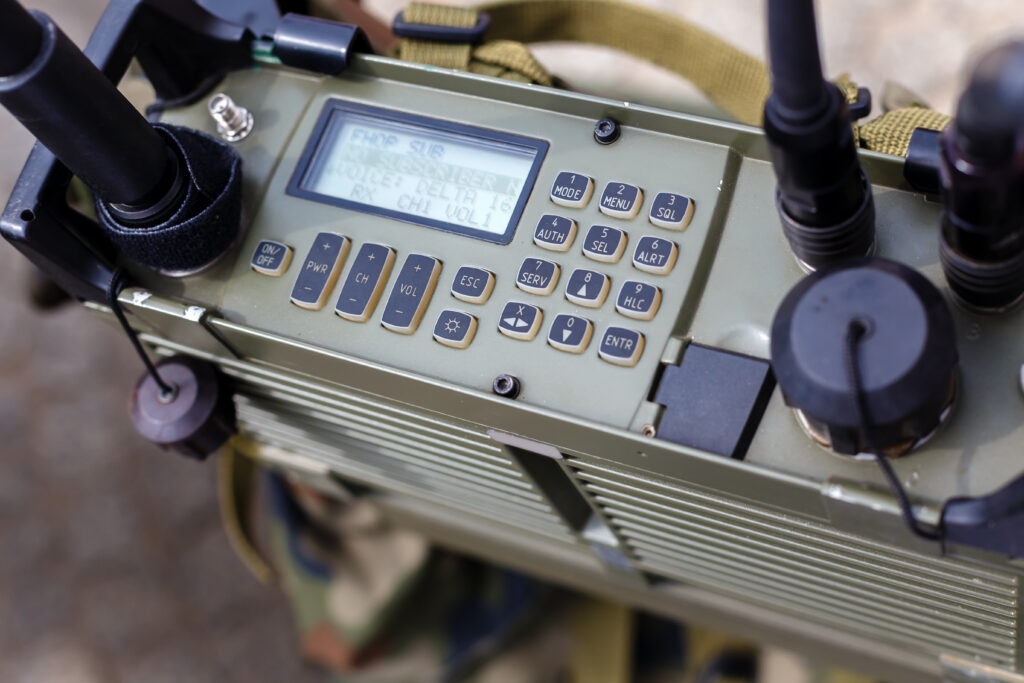
Built for Contested Environments
In distributed operations, range is defined by the ability to sustain connectivity as forces maneuver forward, not simply the distance of a single communication link.
Rajant’s high-power 2.2 GHz radio delivers six watts of mission-ready transmit power within the compact Condor platform, providing extended operational reach, strong receive sensitivity, and reliable signal performance without external amplifiers.
Engineered for contested and high-demand environments, this small form factor system enables secure long-range mesh connectivity while reducing size, weight, and system complexity.
Narrowband radio options operating in 440 MHz and 900 MHz bands extend operational reach even further by leveraging lower-frequency propagation characteristics.
These sub-L-band transceivers support beyond-line-of-sight communications, improve penetration through terrain and structures, and strengthen connectivity in electronically challenged environments.
By prioritizing durability, mobility, and operational reliability, these radio capabilities help sustain mission continuity where long-distance communications are critical.
Range is no longer a fixed number.
It is built, extended, and reshaped by the force itself.

Networking That Moves With the Mission
At the Forward Edge, range and modularity become behaviors of the network rather than fixed characteristics of individual radios.
Instead of relying on a single transmission path, Rajant networking infrastructure enables modular, distributed systems that extend connectivity as forces maneuver.
Manned and unmanned platforms, sensors, and communications nodes combine to form a distributed network that evolves as the mission unfolds.
Disruption is expected. Loss is assumed. Yet communications persist because the network is assembled dynamically at the edge rather than projected from a single vulnerable point of origin.