
Distributed Computing for Real-World Operations
Distributed Computing
Distributed computing places processing, data storage, and application execution directly into the environments where operations occur. Rather than relying on centralized infrastructure or isolated edge devices, distributed computing enables coordinated execution across networked nodes operating in real time. This approach delivers faster decisions, greater resilience, and continuous operation in environments where latency, reliability, and autonomy directly impact outcomes.

How it works
Distributed Computing
for Real-World Operations
Rajant enables distributed computing through Cowbell, a platform designed to operate across mobile, industrial, and mission-critical environments. Built on Rajant’s peer-to-peer Kinetic Mesh, Cowbell distributes compute, data, and intelligence across moving assets, enabling operations to continue even when centralized connectivity is limited, disrupted, or unavailable.
Why Distributed Computing Matters
Organizations across mining, defense, energy, manufacturing, ports, logistics, and public safety increasingly rely on real-time data from sensors, machines, vehicles, and people. Traditional centralized cloud and hub-and-spoke architectures struggle to meet these demands due to latency, bandwidth constraints, and dependence on continuous backhaul connectivity. In safety- and mission-critical environments, these limitations are not just performance issues, they introduce operational risk.
Distributed computing addresses these challenges by placing compute and analytics directly where data is generated. Decisions are made locally, operations continue during network disruptions, and only relevant data is shared across the system. The result is improved responsiveness, higher resilience, and reduced dependency on centralized infrastructure.
Designed for Scale, Distance, and Mobility
Modern operations are no longer confined to fixed locations. They span wide geographic areas, involve moving assets, and evolve continuously. Distributed computing enables this by decentralizing intelligence across nodes that move with people, vehicles, robots, and equipment.
With this architecture, distance is no longer a constraint imposed by centralized systems. Instead, operational reach becomes a function of network topology and deployment strategy, allowing organizations to operate across large, dynamic environments where connectivity may be intermittent, contested, or unavailable.
The Limits of Centralized and Gateway-Centric Models
Many systems marketed as “edge” solutions still rely on centralized control planes, fixed gateways, or cloud-dependent architectures. These approaches introduce critical limitations, including:
- Latency and delay when data must traverse long network paths
- Operational downtime when cloud or backhaul links fail
- Inefficient movement of high-volume data such as video and telemetry
- Complex integrations across disjointed vendors and tools
- Poor suitability for mobile, harsh, or infrastructure-limited environments
These constraints directly impact safety, productivity, and mission success. Distributed computing architectures are designed to overcome these limitations by removing centralized assumptions from runtime operations.
How Rajant Enables Distributed Computing
Rajant’s approach to distributed computing starts with the network.
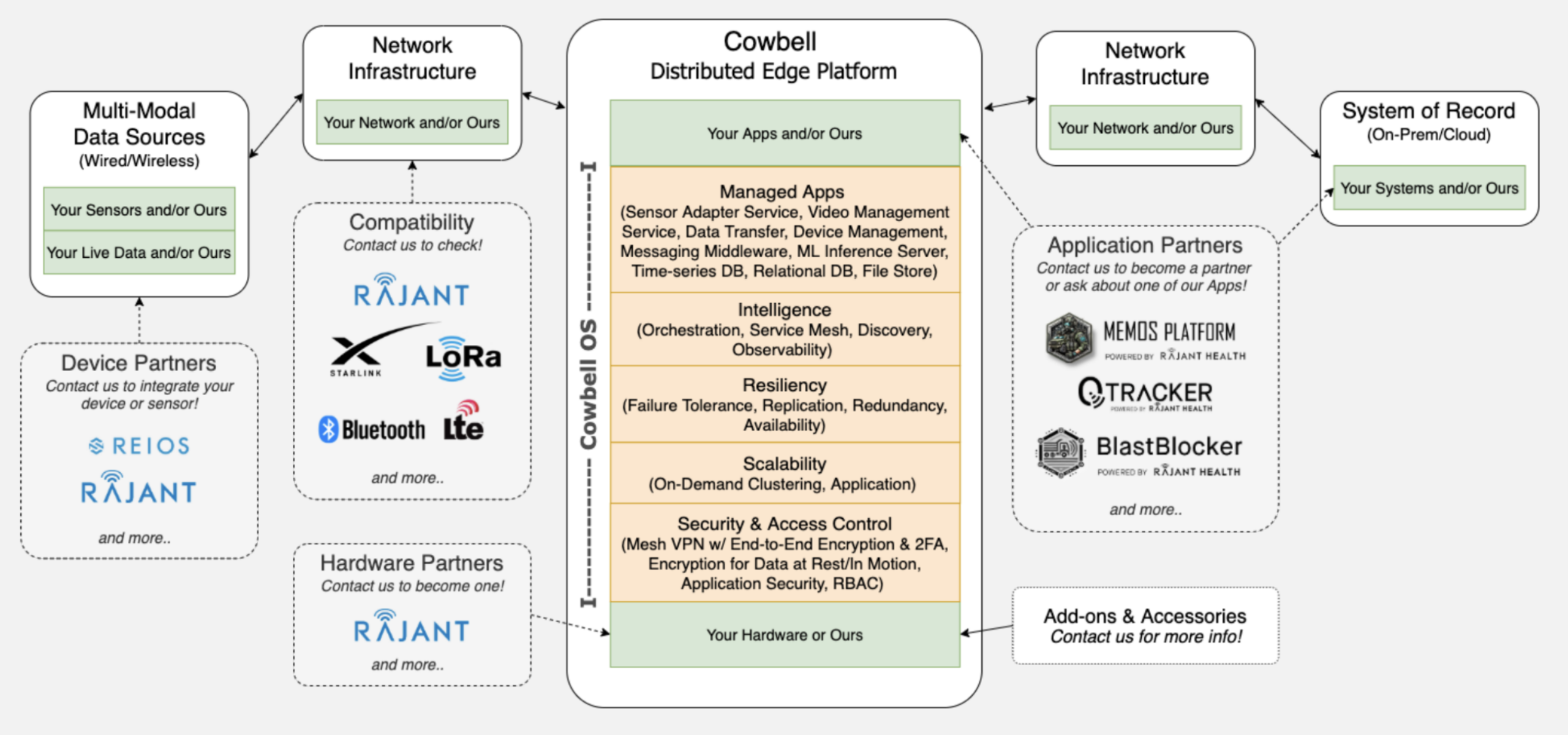
At the foundation is Rajant Kinetic Mesh, a peer-to-peer, multi-path, self-healing wireless mesh designed for mobility and resilience. On top of this fabric, Cowbell delivers a distributed computing platform that coordinates compute, data, and applications directly between nodes.
Key architectural principles include:
- Mesh-enabled mobility
Compute nodes remain connected while moving, without reliance on fixed infrastructure or centralized gateways. - Edge-to-edge coordination
Nodes communicate and share data directly over the mesh, enabling local workload distribution and collaboration without cloud dependency. - Unified distributed platform
Cowbell integrates networking, compute, orchestration, and device integration into a single operational system. - Hardware flexibility
Support for embedded, industrial, and ruggedized compute modules across diverse environments. - Operational scalability
Nodes, applications, and capabilities can be added incrementally as missions and operations evolve.
This architecture allows intelligence to be deployed, scaled, and operated as a distributed system rather than managed as isolated endpoints.
Where Distributed Computing Delivers Value
Distributed computing is especially effective in environments that demand autonomy, resilience, and real-time coordination, including:
- Mining operations with limited fixed infrastructure
- Defense and tactical environments with contested or denied connectivity
- Warehouses and logistics centers using mobile robotics
- Manufacturing lines requiring machine-to-machine coordination
- Remote energy and utility assets
- Ports and maritime operations coordinating moving equipment
In these settings, centralized systems introduce unacceptable risk. Distributed computing enables operations to continue, adapt, and respond in real time.
Distributed Computing with Rajant Cowbell
Cowbell operationalizes distributed computing by turning networking, compute, data, and AI into a cohesive, deployable platform. Cowbell provides:
- Local data processing at the point of capture
- Distributed storage and edge-to-edge data sharing
- Integrated Rajant Kinetic Mesh networking
- Unified sensor and device integration
- Application deployment and updates across distributed nodes
- Real-time analytics and AI inference
- Continuous monitoring and operational management
Together, Rajant and Cowbell deliver a distributed computing system designed for environments where centralized assumptions no longer hold.
White Papers
The Need for Edge Networks, Distributed Computing, and Rajant Cowbell


Order Today

Built for the Edge
Proven Everywhere
From mines and ports to energy fields and defense operations, Rajant delivers resilient, mobile, and intelligent edge networks that keep your mission moving.
Ready to talk specifics for your operation?
Get our products:
Learn More
Frequently Asked Questions
What is Rajant Kinetic Mesh® technology?
Rajant Kinetic Mesh® is an Intelligent Edge networking technology designed for dynamic, mobile environments where traditional fixed infrastructure falls short.
Unlike conventional wireless systems, it enables continuous, adaptive connectivity across moving assets, people, and devices. Powering Industrial AI applications that demand resilience, low latency, and real-time decision-making.
How do Rajant’s BreadCrumb® wireless nodes enhance network connectivity?
Rajant’s BreadCrumb® nodes are the building blocks of a self-forming, self-healing Kinetic Mesh® network.
Each node communicates directly with every other, creating a web of redundant, high-throughput connections that ensure uninterrupted communication, even when conditions change or assets move.
This decentralized design eliminates single points of failure, maximizing uptime and mobility.
InstaMesh® vs. conventional point-to-point connections.
Conventional point-to-point networks depend on fixed links that can break under motion or interference.
Rajant’s InstaMesh® routing protocol dynamically reroutes traffic in real time, automatically choosing the fastest, most reliable path.
The result: continuous, mobile, and intelligent connectivity for operations that never stop moving.
What are the benefits of Rajant’s InstaMesh® for IIoT applications?
For Industrial IoT environments, InstaMesh® provides the low-latency, adaptive communication required to keep machines, sensors, and AI systems synchronized.
It delivers instant data exchange, self-healing reliability, and scalable capacity, empowering predictive maintenance, automation, and autonomous decision-making at the edge.
How can Rajant Kinetic Mesh support real-time tele-operations in mines?
Mining operations depend on remote visibility and control where connectivity is often limited.
Rajant’s Kinetic Mesh® delivers real-time communication and video streaming for tele-remote equipment and autonomous vehicles, even underground.
Its multi-radio BreadCrumb® nodes maintain reliable signal and low latency. Keeping operators safely in control from any distance.
Rajant Kinetic Mesh network vs. traditional WiFi solutions.
Traditional WiFi networks are static, fragile, and reliant on centralized infrastructure.
Rajant’s Kinetic Mesh® replaces those limits with a dynamic, peer-to-peer architecture, where every node acts as both transmitter and receiver.
This ensures continuous, adaptive coverage, ideal for moving assets and mission-critical applications where downtime is not an option.
Discover Rajant’s solutions for tunnel communications.
Tunnels and underground environments are notoriously difficult for wireless communication.
Rajant’s BreadCrumb® nodes create a linear, mobile mesh network that maintains signal integrity through long corridors, curves, and obstructions.
This allows real-time monitoring, voice, and video for mining, utilities, and public safety teams.
How does Rajant’s technology enhance machine-to-machine communication?
Rajant’s InstaMesh® routing enables machines to communicate directly and continuously, without depending on static access points.
This machine-to-machine (M2M) intelligence ensures critical data is shared instantly, fueling automation, robotics coordination, and AI-driven optimization across industrial environments.
Cost of implementing a Rajant Kinetic Mesh network.
Implementation costs vary based on network size, environment, and application.
However, Rajant’s decentralized design significantly reduces the need for fixed infrastructure, cabling, or complex configuration.
Resulting in a lower total cost of ownership and faster ROI compared to traditional networking systems.
How do BreadCrumb® nodes work in enhancing network resilience?
Each BreadCrumb® acts as a multi-radio, multi-frequency transceiver that maintains multiple simultaneous connections.
If one path is interrupted, InstaMesh® instantly reroutes data through another, creating always-on resilience that keeps communications live even under extreme conditions.
Maximize network uptime with Rajant’s solutions.
Rajant eliminates the single points of failure found in traditional networks.
Its multi-path, self-healing mesh keeps assets connected, even as they move, ensuring maximum uptime and operational continuity in industries where every second counts.
What industries benefit most from Rajant’s Kinetic Mesh technology?
Rajant’s Intelligent Edge networks power operations across mining, ports, logistics, defense, manufacturing, public safety, agriculture, and energy.
Wherever mobile assets, automation, and Industrial AI intersect, Rajant delivers real-time, reliable communication to keep data flowing and decisions immediate.
Comparing Rajant Kinetic Mesh with LTE solutions.
LTE depends on centralized infrastructure and licensed spectrum, creating latency and coverage limits.
Rajant’s Kinetic Mesh® offers a private, infrastructure-free alternative with ultra-low latency, flexible frequency use, and no dependency on towers or carriers. It’s built for mobility, autonomy, and data sovereignty.
Rajant Kinetic Mesh network integration with existing infrastructure.
Rajant networks are designed for seamless integration.
BreadCrumb® nodes connect easily with existing Ethernet, LTE, and satellite systems extending coverage, strengthening resilience, and modernizing legacy networks without disruption.
Do you sell direct?
Rajant primarily sells through our authorized partners and distributors, who bring deep expertise in deploying Intelligent Edge networking solutions across a range of industries.
This collaborative approach ensures customers receive tailored integration, local support, and end-to-end service from network design to deployment.
To find a Rajant distributor near you, visit our distributor page.