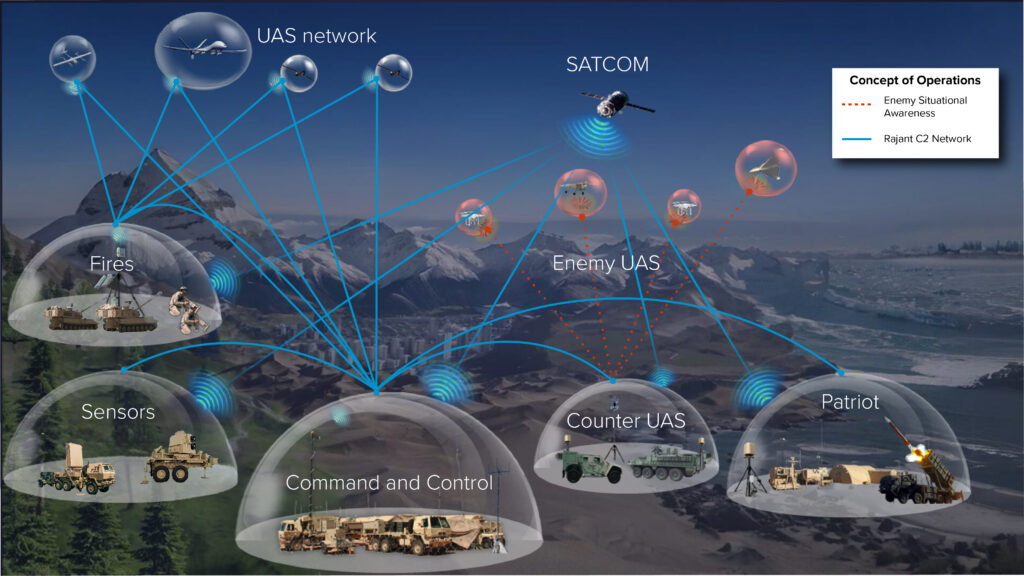
Architecture Overview
Distributed Mesh Nodes
Rajant nodes are deployed across vehicles, unmanned platforms, command elements, and fixed positions. Each node acts as both a network participant and a routing point, allowing communications to extend organically as additional nodes join the network.
Multi-Transport Connectivity
Rajant networking integrates multiple communication transports including:
- Tactical radios
- Satellite links
- Cellular networks
- Private wireless systems
- Wired infrastructure
Rather than replacing these systems, Rajant connects them into a unified network environment.

Real-Time Path Optimization
Every node continuously evaluates network conditions and selects the most effective route for each packet.
This allows traffic to automatically move across multiple links, hops, and communication technologies as conditions change.
Edge-Distributed Architecture
Network intelligence is distributed across the mesh rather than centralized in a single control point.
This allows the network to continue operating even when individual nodes move, fail, or are disrupted.
Continuous Adaptation
As platforms maneuver and operational conditions evolve, the network dynamically reconfigures itself to maintain connectivity and data flow.
This allows communications to move with the mission rather than depend on fixed infrastructure.

Rajant’s architecture supports mission environments where:
- Autonomous systems require reliable connectivity
- Distributed forces operate across large areas
- Sensors and platforms must share data in real time
- Infrastructure cannot remain fixed or centralized
- Communications must remain resilient under disruption
Rajant networking infrastructure allows distributed defense systems to operate as a coordinated whole, supporting reliable communications across platforms, environments, and mission condition