

• Skip to main content
  • Skip to header right navigation
  • Skip to site footer

Search

Tech Support

Partner Portal

Where to Buy

Register Now for the 2026 Rajant Partner Summit – May 4-7 →

The image shows the word "RAJANT" in blue capital letters. The letter "A" has a wireless signal icon above it, integrating with the design to suggest connectivity or communication.

Rajant

Innovators of intelligent wireless edge network solutions.

  • Solutions
    • BreadCrumb® Wireless Nodes
    • Services
    • RiSM
    • Rajant Guardian
    • Accessories
    • Rajant Health
    • Reios
  • Markets
    • Mining
    • Defense
    • Ports
    • Heavy Construction
    • Oil, Gas & Energy
    • Utilities
    • Rail
    • Public Safety
    • Warehouse Automation
    • Agriculture
    • Rural Broadband
    • Service Providers & Telecom
    • Public Venues & Events
  • Technology
    • Distributed Computing
    • Kinetic Mesh®
    • InstaMesh®
    • Cryptography
    • Artificial Intelligence
    • Autonomy & Robotics
    • Industrial Security
    • Tunnel Communications
  • Products
    • Antennas
    • Cable Accessories
    • Cardinal
    • Condor
    • Cowbell
    • DX Series
    • ES1 Series
    • Hawk FE1-2450G (5G)
    • Hawk Series
    • High-Vibe Sparrow
    • JR Series BreadCrumb®
    • LTE Enhance
    • Needletail
    • Peregrine
    • Peregrine FE1-2255X
    • Peregrine for Licensed Frequencies
    • Peregrine LTE
    • Power Accessories
    • QStat
    • Rajant Mobile Apps
    • SlipStream
    • SLP-1025 SlipStream
    • Sparrow
  • Services
    • Rajant Guardian
    • BC|Commander Suite
  • Resources
    • Webinars
    • Brochures
    • Spec Sheets
    • White Papers
    • Case Studies
    • Videos
    • Articles
  • Latest
    • Press Releases
    • Podcasts
    • Media Coverage
    • Our Blog
    • Newsletters
    • Upcoming Events
    • 2026 Partner Summit
  • Partnering
  • About
    • About
    • Purpose
    • History
    • Maintenance & Support
    • Powered By Rajant
    • Rajant Leadership
    • Subject Matter Experts
    • Careers
  • ← Return to Main Site
  • Military Overview
  • Technology
    • How Rajant Works
    • Kinetic Mesh
    • Instamesh
    • Security
    • Resiliency
    • Range
    • Modularity
    • Military Architecture
  • Products
    • Cardinal
    • Condor
    • Cowbell
    • DX Series
    • FINCH
    • Peregrine
    • QStat
    • RiSM
    • SLP-1025 SlipStream
  • Demos and Deployments
    • Demos
    • Deployment Scenarios
    • Press Releases
  • Tech Support
  • Partner Portal
  • Where to Buy
  • Contact Us
  • Contact Us
Contact
Contact
Search
A telecommunications tower with multiple antennas stands against a blue sky, surrounded by a digital network of glowing, interconnected lines and nodes, symbolizing wireless communication and connectivity.

Why Industrial Wireless Must Move Beyond Towers

For years, industrial wireless networks have been designed around a simple assumption: if you want reliable coverage, you build more towers. That approach worked when operations were static and predictable. But today’s industrial environments—mines, ports, rail yards, construction sites, and energy facilities—are anything but.

Operations move. Assets relocate. Terrain changes. Temporary infrastructure becomes permanent. And yet, we continue to force rigid, tower-centric wireless architectures into dynamic environments. The result is predictable: coverage gaps, rising costs, operational risk, and networks that struggle to keep pace with the work they’re meant to support.

It’s time to go beyond towers.

Providing insight into the subject of remote and mobile wireless communications, Andrew Martin, Vice President of Product Management and Strategy at Rajant Corporation, shares his experience in the field. Andrew shares why mesh-based systems are becoming essential for reliable network performance in today’s dynamic industrial operations.

The Limits of Fixed Wireless Thinking

Traditional wireless networks are built around fixed points of control. Towers, access points, and centralized cores define where connectivity exists—and where it doesn’t. In industrial settings, that rigidity quickly becomes a liability. As soon as equipment moves beyond coverage, or physical obstructions change the RF environment, performance degrades. Expanding coverage usually means building or relocating towers, which are expensive, slow, and often impractical in remote or temporary operations.

More importantly, tower-centric designs introduce single points of failure. When connectivity depends on a limited number of fixed assets, downtime becomes inevitable. In industries where automation, tele-remote operation, and real-time data drive productivity and safety, even brief interruptions can have serious consequences.

Mobility Changes the Network Equation

Industrial networks must follow the work—not the other way around. Vehicles, machines, autonomous systems, and personnel are already mobile. The network supporting them must be equally dynamic.

This is where mesh networking fundamentally changes the equation. Instead of relying on towers as the backbone, a mesh network distributes intelligence across the edge. Every node becomes both a user and a contributor to the network, allowing connectivity to extend organically as assets move. Coverage is no longer defined by where towers stand, but by where operations take place. 

At Rajant, we built Kinetic Mesh® with this reality in mind. Our architecture treats wireless mesh and cellular links as peers within a single Layer 2 distributed network. Traffic is continuously evaluated and routed based on real-time conditions. If a path degrades or disappears, the network instantly adapts—without manual intervention and without disruption to applications.

Towers as Capacity, Not Constraints

This isn’t an argument against private LTE or 5G. Cellular technologies deliver tremendous value, particularly for high-bandwidth and wide-area coverage. The problem arises when they are treated as the foundation rather than a component.

In a mesh-centric architecture, towers become optional capacity instead of architectural anchors. They can be used when available and bypassed when they’re not. This dramatically reduces the number of towers required to achieve reliable site-wide connectivity, while also lowering congestion and improving overall network performance.

By integrating mesh directly with LTE and 5G (see figure 1 below) rather than layering one on top of the other, industrial operators gain flexibility. The network can dynamically choose the best path—mesh, cellular, or wired—for each packet, based on latency, throughput, and reliability requirements.
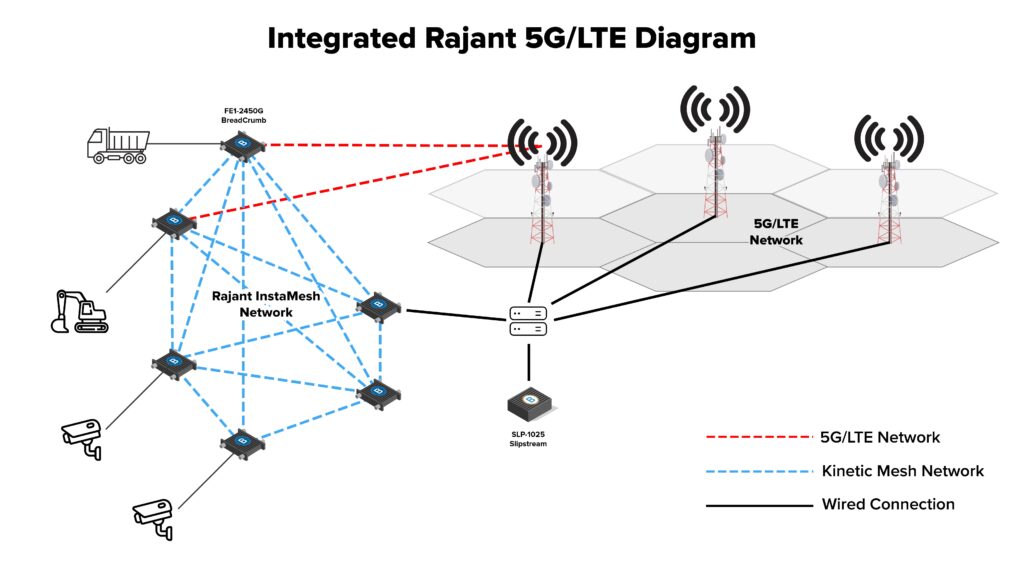
Diagram showing an integrated Rajant 5G/LTE network, with devices connected via blue dashed lines for Kinetic Mesh, red dashed lines for 5G/LTE, and black lines for wired connections to network towers.

Figure 1. depicts a Rajant Kinetic Mesh network and the capabilities they have integrated with 5G/LTE networks with the new SLP-1025 and Hawk FE1-2450G BreadCrumbs. 

Extending Reliability Beyond the Cell Edge

As industrial sites push further into automation and AI-driven systems, the demand for consistent, low-latency connectivity continues to grow. Small 5G cells alone can’t always meet that demand, especially in remote locations or environments with shifting layouts.

That’s why we’ve focused on extending mesh reliability into cellular environments. By combining high-performance wireless mesh nodes with integrated 5G/LTE capabilities, and enabling intelligent path selection at the core, we eliminate the traditional boundary between mesh and cellular networks. The result is a unified architecture that maintains application uptime even as assets move, conditions change, or infrastructure shifts.

This approach also simplifies deployment. Instead of building complex, tower-heavy architectures or relying on multiple temporary solutions like COWs, operators can design networks that are resilient from day one—and adaptable over time.

A Better Model for Industrial Wireless

Going beyond towers isn’t about abandoning existing infrastructure. It’s about rethinking how that infrastructure is used. Distributed, self-healing networks reduce risk, lower costs, and scale naturally with operations. They align with the realities of industrial work instead of fighting against them.

As industries continue to adopt autonomy, remote operations, and data-driven decision-making, the networks supporting them must be just as intelligent and resilient. Mesh networking provides a foundation—one where connectivity is no longer limited by where towers can be built, enabled by where the work actually happens. If you want to learn more on how our Kinetic Mesh network can enable better wireless communications for preexisting 5G/LTE, you can reach out to Andrew on LinkedIn. If you are inquiring about Rajant’s intelligent edge technology, then a Rajant representative will assist you in finding the best products for your site needs.  

Alternatively, you can read our white paper on LTE/5G vs Kinetic Mesh technology.

Share this post
Category: ConnectivityTag: BreadCrumbs, Kinetic Mesh, Rajant, wireless communications, wireless mesh network
A man with short brown hair and light stubble wears a brown leather jacket over a collared shirt, looking directly at the camera. The background is a blue-gray gradient.

About Andrew Martin

Andrew Martin is Vice President of Product Management and Strategy for Rajant Corporation where he runs the product strategy and product roadmap for the business. He has 25 years of experience working in tech, with focus in edge sensor deployments, Industrial IoT, Artificial Intelligence / Machine Learning, SaaS solutions and BI analytics software.

Andrew holds 17 patents across 9 topics and 6 publications. He received his Masters in Industrial Engineering, Masters of Business Administration and Bachelor of Science in Mechanical Engineering from University of Pittsburgh, as well as a Bachelor of Arts in Mathematics from St Vincent College.

LinkedIn

Sidebar

Recent Posts

  • Eliminating Warehouse Downtime: How Rajant Optimizes Operational Performance by Keeping AMRs and AGVs Connected and In Motion
  • Your 2026 Rajant Event Calendar: Where to Meet the Team and See Live Tech in Action
  • Rajant Corporation Appoints Ambassador Kenneth J. Braithwaite to Board of Directors
  • Improving Operations in Quarries and Landfills
  • Las Vegas, NV – Booth 2022

Categories

  • Agriculture
  • Articles
  • Autonomy & Robotics
  • Brochures
  • Case Study
  • Connectivity
  • Defense
  • Equestrian
  • Featured
  • Federal/Military/Civilian
  • Healthcare
  • Heavy Construction
  • Industrial Indoor Wi-Fi
  • Industrial Security
  • Infographic
  • Maintenance & Support Program
  • Media Coverage
  • Mining
  • Municipality/Public Safety
  • News
  • Newsletters
  • Oil & Gas
  • Petrochemical
  • Ports
  • Press Releases
  • Rail
  • RHI
  • Tunnel Communications
  • Uncategorized
  • Upcoming Events
  • Utilities
  • Warehouse Automation
  • Webinar
  • White Paper

Order Today


By submitting, you agree with Rajant's Privacy Policy.

A blue world map with six circular markers highlighting locations in North and South America, including the United States, Mexico, and Brazil. The rest of the world is shown without markers.

Built for the Edge

Proven Everywhere

From mines and ports to energy fields and defense operations, Rajant delivers resilient, mobile, and intelligent edge networks that keep your mission moving.

Ready to talk specifics for your operation?

Talk to an Expert

Get our products:

Select Your Region

Our Blog

Latest Posts


Two autonomous robots transport cardboard boxes across a warehouse floor, with shelves of stacked boxes in the background. The scene is well-lit and organized, highlighting automated logistics technology.

Eliminating Warehouse Downtime: How Rajant Optimizes Operational Performance by Keeping AMRs and AGVs Connected and In Motion

Why Mobile Automation Magnifies Wireless Failures Warehouse automation does not fail all at once. It breaks down in small moments, when robots …
Read moreEliminating Warehouse Downtime: How Rajant Optimizes Operational Performance by Keeping AMRs and AGVs Connected and In Motion
A trade show booth for Rajant displays technology solutions with a large screen, informational materials, and device demos. Visitors are walking by on a purple-carpeted floor in a busy exhibition hall.

Your 2026 Rajant Event Calendar: Where to Meet the Team and See Live Tech in Action

Why In-Person Events Still Matter in 2026 Rajant, a global leader in intelligent edge networking and the creators of Kinetic Mesh®, InstaMesh®, and …
Read moreYour 2026 Rajant Event Calendar: Where to Meet the Team and See Live Tech in Action
A wide panoramic view of an open-pit quarry with terraced rock walls and scattered mining equipment on the dusty floor, surrounded by trees and under a partly cloudy sky.

Improving Operations in Quarries and Landfills

Download PDF
Read moreImproving Operations in Quarries and Landfills
White text on a light gray background reads: "RAJANT" with a wifi signal above the letter "A", followed by "INTELLIGENT EDGE Enabling Industrial AI" in italicized font.

200 Chesterfield Pkwy
Malvern, PA 19355

Company

About Us
Purpose
History
Maintenance & Support
Powered By Rajant
Subject Matter Experts
Careers

Solutions

BreadCrumb® Wireless Nodes
Services
RiSM
Rajant Guardian
Accessories
Rajant Health
Reios

Technology

Distributed Computing
Kinetic Mesh®
InstaMesh®
Cryptography
Artificial Intelligence
Autonomy & Robotics
Industrial Security
Tunnel Communications

Talk to our sales team

1-484-595-0233

Gold text reads "25 Years Wireless Edge Innovation" with two abstract gray radar antennas in the background on a light gray background.
  • X
  • YouTube
  • Facebook
  • Instagram
  • LinkedIn

© 2026 Rajant Corporation. All Rights Reserved.

Privacy Policy

Terms and Conditions

Responsible Disclosure Policy

An illustration of the American flag waving on the left, with a blue background on the right displaying the white text "MADE IN USA.
This site uses cookies to collect information about your browsing activities in order to provide you with more relevant content and promotional materials, and help us understand your interests and enhance the site. By continuing to browse this site you agree to the use of cookies. Visit our privacy policy to learn more.