
Why Mobile Automation Magnifies Wireless Failures
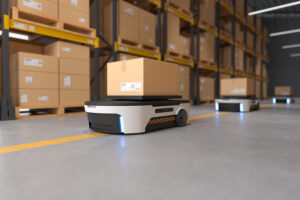
Warehouse automation does not fail all at once. It breaks down in small moments, when robots hesitate, pause, or lose connection at the wrong time. As organizations deploy fleets of autonomous mobile robots (AMRs), automated guided vehicles (AGVs), and other connected systems, continuous wireless connectivity becomes essential to keeping operations moving. These systems depend on real-time communication to navigate, receive tasks, and coordinate with warehouse management platforms. When that connection becomes unstable, robots stop, wait to reconnect, or enter safety states that interrupt workflows and reduce throughput.
This is where Rajant’s mesh-based networking approach, based on our patented Kinetic Mesh® technology, provides a different path forward. Instead of relying solely on fixed infrastructure and seamless handoffs, Rajant Kinetic Mesh® enables moving assets to communicate dynamically with multiple nodes across the entire warehouse. By supporting InstaMesh®’s self-healing network behavior, mesh networks can maintain communication even as devices move through coverage gaps, interference-heavy zones, changing layouts. In highly dynamic warehouse environments, this approach helps reduce single points of failure and supports more consistent connectivity for mobile automation systems.
As warehouses become more automated, the reliability of the wireless network becomes a critical part of keeping operations moving. Brad Viernow, Director of Sales at Rajant Corporation joins us with experience supporting large-scale industrial networks in warehouse environments.
Case Example: How Wi-Fi Dropouts Can Halt Autonomous Warehouse Productivity
Consider a facility operating hundreds of AMRs/AGVs across a large warehouse, where robots constantly communicate with each other and the warehouse management system platform to receive tasks and report their location. When wireless communication is stable, assets can move continuously through aisles, staging zones, and loading areas as needed, in order to keep product demand moving. But when moving assets pass through specific areas, brief Wi-Fi disruptions can occur due to coverage gaps, interference, and RF delays.
Each time wireless communication drops, the AMRs/AGVs automatically pause while attempting to reconnect. What may only last seconds can quickly compound as they pass through the same location during peak hours. Mobile assets begin to queue in aisles or other important areas, slowing surrounding traffic and interrupting task assignments.
The result is a ripple effect across the operation. Workers may need to manually reset robots, reroute tasks, or move stalled units, while orders begin to fall behind schedule. When moving assets unexpectedly stop in critical areas such as congested aisles, and loading lanes workers may need to clear blocked paths and reroute tasks, decreasing ROI for efficiency due to the manual interventions that may be spent. In environments that depend on continuous automation, even brief Wi-Fi dropouts can translate into measurable productivity loss.
Engineering Limitations of Wi-Fi in Dynamic Warehouses
Designing reliable wireless communication in a warehouse environment is difficult because the physical space is constantly changing. Facilities with tall ceilings, dense metal shelves, and moving inventory create conditions where wireless signals reflect, scatter, and weaken. As AMRs, AGVs, forklifts, and workers move through aisles and storage zones, they can temporarily block signal paths or create interference. A traditional network may begin to struggle as automation scales an increase in the number of assets, increasing wireless congestion and the frequency of roaming events between access points.
Mobility introduces another layer of complexity. Assets that are traveling must continuously transition between network nodes while maintaining communication with each other or the management system. In environments with high rack density, metal structures, and machinery interference, these handoffs can result in brief connection interruptions or packet loss. For robots performing real-time navigation, coordinated picking, and dynamic routing, even short disruptions can trigger pauses and tasks. Integrating BreadCrumbs to each of these assets enables real-time communication and real-time awareness to where each of the assets are located.
Because of these limitations, some organizations explore networking approaches designed specifically for highly mobile industrial environments. Kinetic Mesh® integrated with InstaMesh® technology, is built to support mobile nodes, robotic fleets and industrial vehicles operating across large facilities and changing RF conditions. This enables several solutions to solve this: peer-to-peer communication, mobile node networking, dynamic routing, and resilient connectivity. Kinetic Mesh’s architecture can help maintain communication even when devices move through coverage gaps, and interference-heavy areas, reducing the likelihood that wireless disruptions will interrupt automated workflows.
How Rajant Enables Seamless Connectivity for AMRs / AGVs
Rajant helps address the connectivity challenges of mobile automation by enabling continuous, resilient communication for AMRs and AGVs as they move throughout the facility. Unlike traditional infrastructure that relies solely on fixed access points, Kinetic Mesh® allows for mobile network nodes, assets and autonomous vehicles to communicate using peer-to-peer networking, mobile mesh architecture, and dynamic node-to-node communication. This approach allows robots to maintain connectivity while traveling through large warehouses, dense metal shelving environments, and complex industrial layouts, reducing the likelihood that a single point of failure will interrupt operations.
As assets move through and between coverage zones, aisles, and loading zones, Kinetic Mesh® enables them to dynamically exchange data with other BreadCrumb® mesh nodes, preexisting infrastructure devices and control systems without relying entirely on handoffs between fixed access points. By supporting self-healing InstaMesh® network behavior, dynamic rerouting, and multi-path communications, the network can adapt to interference, physical obstructions, and changing layouts that commonly affect wireless performance in warehouse environments.
This type of architecture is designed to support the growing demands of mobile automation, where the number of robots and real-time coordination continues to increase. With Kinetic Mesh®, organizations can build networks that prioritize continuous wireless communication, mobility support, and operational resilience, helping keep AMR fleets moving even in dynamic warehouse environments.
Safety and Organizational Impacts
Wireless disruptions in automated warehouses affect more than productivity. Mobile AGV depends on constant communication with the management system to navigate safely and coordinate with other machines and workers. When wireless communication drops, AGVs often trigger a safety stop system until communication with the network is restored. While these mechanisms protect people and equipment, repeated interruptions can create congestion in high-traffic zones or shared human-robot workspaces, slowing operations and increasing the likelihood of workflow disruptions.
These events can also create broader organizational challenges. At the same time, diagnosing the root cause often requires seamless coordination between IT teams, and warehouse operations. What begins as a wireless communication issue can quickly impact safety procedures, operational planning, and overall warehouse efficiency.
Best Practices for Warehouse Network Modernization
As warehouse automation operations continue to scale, network reliability becomes a foundational requirement for keeping operations running smoothly. Facilities that rely on AMRs, AGVs, and other connected systems need wireless infrastructure that can support constant mobility, high device density, and real-time communication. Modernizing the warehouse network is not simply about improving coverage. It is about designing wireless communication that can support the operational demands of AGV fleets, real-time systems, high-throughput fulfillment environments while minimizing the risk of disruptions that can stall automated workflows.
Organizations looking to modernize warehouse connectivity often focus on several key strategies:
- Evaluate network coverage in motion. Assess how AGV and vehicles move through aisles and pick zones to identify potential coverage gaps and interference zones.
- Plan for automation scale. Design networks to support current assets and future expansion, ensuring sufficient capacity for real-time, fleet coordination and operational data exchange.
- Address environmental interference. Consider how metal shelving, large machinery, moving inventory, and foundational materials affect signal performance and incorporate BreadCrumb network nodes that can adapt to changing RF conditions and dynamic layouts
- Support mobility first wireless communication. Implementing Kinetic Mesh, designed for moving assets and industrial vehicles, can maintain communication as devices move across distributed facilities.
- Prioritize operational resilience. Evaluate technologies that provide redundant communication paths, self-healing networking, and peer-to-peer connectivity to reduce the risk that a single network disruption will interrupt robot workflows and warehouse operations.
For warehouses investing in mobile automation, building a network designed for mobility and resilience can help keep robotic fleets operating consistently as environments, workloads, and automation density evolve. Reliable connectivity becomes an important part of maintaining both operational efficiency and system coordination across the facility.To learn more about the networking considerations behind automated warehouse environments, you can connect with Brad on LinkedIn. He regularly shares insights on wireless infrastructure, industrial mobility, and the role of resilient networking in supporting warehouse automation. Alternatively, contact a Rajant representative to get started by integrating our Kinetic Mesh® technology into your preexisting warehouse systems.
