
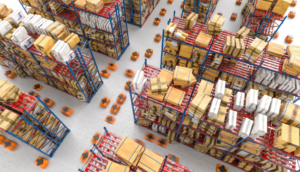
Warehouse automation is entering a new phase. Autonomous systems are no longer isolated machines executing predefined instructions; they are becoming intelligent agents that collaborate, adapt, and make decisions together at the edge.
As autonomous mobile robots (AMRs), robotic picking systems, and autonomous material handling equipment scale across warehouse environments, the limiting factor is no longer robotics capability. It is coordination. And coordination, at machine speed, depends entirely on the network.
Rajant’s InstaMesh® technology provides the edge-to-edge coordination fabric required to move warehouse automation from centrally managed robotics to distributed, agent-to-agent autonomy.
Paul Hellhake, President and CTO from Rajant Corporation, shares how Rajant’s intelligent edge solutions enable autonomous robotics across industrial environments such as warehouses. He explores how InstaMesh® technology is a critical enabler of real-time decision-making, operational resilience, and maximum efficiency in highly dynamic environments.
From Edge-Controlled Machines to Intelligent Agents
Edge-controlled machinery refers to systems that sense, compute, decide, and act locally, without reliance on centralized cloud platforms or fixed controllers. In warehouses, where layouts change, assets move constantly, and RF conditions are unpredictable, edge control is essential for reliability and safety.
But edge control alone is no longer sufficient.
The next evolution is agent-to-agent (A2A) autonomy, where machines behave as intelligent agents that:
- Discover and authenticate one another directly
- Share situational awareness in real time
- Negotiate task ownership, routing, and priorities
- Coordinate actions without centralized orchestration
In this model, autonomy emerges from peer collaboration rather than top-down control. For A2A systems to succeed in real-world warehouse environments, machines must communicate laterally, directly and continuously, at the edge.
This is where most traditional networks fail.
Why Networks Become the Bottleneck
Conventional wireless architectures, Wi-Fi, LTE, and private cellular, were designed for client-server communication. Devices talk upward (north-south) to access points, controllers, or cores, not sideways (east-west) to each other. Traditional Wi-Fi and LTE architectures, optimized for client-server traffic and centralized control, struggle to support the lateral, real-time communication required by agent-to-agent systems
Agent-to-agent systems invert this model. A2A traffic is:
- Predominantly peer-to-peer (east–west)
- Highly dynamic
- Extremely sensitive to latency, mobility, and interruption
In warehouse environments filled with metal shelving, narrow corridors, moving inventory, and mobile robots, controller-centric networks introduce handoff delays, session drops, and single points of failure. These weaknesses undermine real-time autonomy.
To enable agent-based systems, the network itself must become decentralized, mobile, and adaptive, mirroring the autonomy of the machines it supports.
The Rajant Intelligent Edge: Distributed by Design
Rajant BreadCrumb® nodes form the foundation of an Industrial Internet of Things (IIoT) ecosystem that connects machines, vehicles, sensors, and infrastructure into a fully distributed network.
Rajant’s Cowbell OS incorporates distributed edge computing, extending intelligence directly into the network. Rather than relying on centralized controllers, every node actively participates in routing, optimization, and resilience.
This architecture allows warehouse networks to move, adapt, and heal themselves in real time, without human intervention or cloud dependency.
At the core of this capability is Rajant’s patented InstaMesh® protocol.
InstaMesh®: The Coordination Fabric for Agent-to-Agent Autonomy
InstaMesh® is not simply a wireless routing protocol. It is the coordination fabric that enables agent-to-agent communication at machine speed.
Unlike traditional routing systems that rely on periodic updates and static paths, InstaMesh® continuously evaluates all available wired and wireless links and makes per-packet routing decisions in real time. Each packet is forwarded along the lowest-latency, most reliable path available at that moment.
Key advantages of InstaMesh® include:
- True peer-to-peer communication without controller detours
- Instant rerouting around interference, congestion, or node loss
- Seamless mobility, even with fast-moving or swarming assets
- Near-zero downtime during network expansion or reconfiguration
- Operation without backhaul, enabling autonomy even when isolated
Because InstaMesh operates transparently at Layer 2, it supports emerging agent-to-agent frameworks without requiring changes to robot software or autonomy stacks. The network enables autonomy; it does not constrain it.
In effect, InstaMesh® becomes the digital nervous system of the autonomous warehouse.
Warehouse Use Case: Autonomous Systems That Collaborate, Not Isolate
In an A2A-enabled warehouse, autonomous mobile robots do more than follow routes. They coordinate as a collective system.
AMRs dynamically share:
- Location and congestion data
- Task status and availability
- Environmental awareness
As conditions change, blocked aisles, rerouted inventory flows, shifting priorities—robots negotiate and adapt workflows in real time. There is no fragile dependency on fixed access points or centralized schedulers.
By embedding Rajant BreadCrumb® nodes into autonomous machinery, each robot becomes both:
- An intelligent agent
- A mobile network asset
Coverage expands organically as machines move, eliminating infrastructure bottlenecks. Even in RF-challenged environments with metal shelving and complex layouts, InstaMesh maintains uninterrupted, low-latency connectivity between peers.
The result:
- Fewer manual touches
- Improved inventory accuracy
- Predictable, resilient workflows
- Safer and more efficient use of human labor
Autonomy becomes reliable, not brittle.
Kinetic Mesh® vs. Wi-Fi and LTE: Why Architecture Matters for Agent-to-Agent Autonomy
Wi-Fi and LTE were designed for centralized client-server communication. Devices connect upward to access points, controllers, or base stations, and the network enforces structure through handoffs, roaming decisions, and centralized control logic.
In agent-to-agent systems, this model becomes a liability.
Wi-Fi networks rely on controller-managed roaming and periodic convergence. As autonomous machines move, sessions are paused or renegotiated, introducing latency spikes and transient disconnects that disrupt real-time peer coordination. LTE introduces similar challenges through centralized cores and handoff mechanisms, along with added cost and operational complexity.
Rajant’s Kinetic Mesh® eliminates these constraints entirely.
With no controllers, no handoffs, and no fixed hierarchy, InstaMesh® allows autonomous agents to communicate directly and continuously, even while moving at speed or operating in RF-challenged environments. Peer traffic remains local, routes adapt per packet, and coordination continues uninterrupted, even when infrastructure is disrupted or unavailable.
For agent-to-agent autonomy, this architectural difference is decisive. Autonomous systems cannot wait for networks to converge. They require a fabric that adapts instantly, heals automatically, and moves at the same speed as machine intelligence.
The Future: Distributed Intelligence at the Edge
The future of warehouse automation is not centralized control, it is distributed, agent-based intelligence operating at the edge.
Rajant’s intelligent edge solutions, powered by InstaMesh®, provide the resilient, real-time coordination fabric required to make this future operational today. By enabling machines to communicate directly, adapt continuously, and collaborate autonomously, Rajant transforms robotics from isolated automation into collective intelligence.
This is more than connectivity. It is the foundation for scalable, resilient, edge-controlled autonomy in warehouse operations.
To learn more about how Rajant enables agent-to-agent autonomy and intelligent edge networking, connect with Paul Hellhake on LinkedIn or contact a Rajant representative to explore how InstaMesh® can transform your warehouse operations.
