
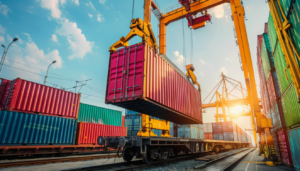
The Rise of Port Automation
Modern ports face growing pressure to move goods faster and with greater accuracy, while maintaining safety and reducing operational costs. As global trade continues to expand, automation has become essential for improving container handling, vessel turnaround, and yard management.
Automated cranes, autonomous vehicles, tele-operation systems and Industrial Internet of Things (IIoT)-enabled sensors all depend on continuous communication to operate safely and efficiently. Rajant’s intelligent edge solutions provide the low-latency, always-on wireless communications required to keep these systems running smoothly. By enabling seamless mobility and adaptability across complex port environments, it supports true operational autonomy and real-time improvements from the quay to the gate.
To share an expert perspective on the evolving landscape of port automation, we turn to Oscar Velazquez, at Rajant Corporation. With years of involvement in deploying Rajant’s intelligent edge solutions in complex port environments, Oscar offers valuable insight into how reliable, mobile wireless communications and industrial IA applications are transforming port operations.
Yard Environment Networking Problems
Industrial yards present some of the toughest conditions for maintaining reliable wireless communication. Constant vehicle movement, stacked containers, metal obstructions, and shifting layouts can all interfere with signal quality and network performance. Traditional infrastructure, such as fixed Wi-Fi access points or cellular systems, often struggles to provide consistent coverage and to maintain constant operations in these changing spaces
These challenges directly impact real-time coordination, automation, and asset tracking, especially as more yard operations rely on connected systems and tele-remote equipment. Overcoming these obstacles requires a networking approach designed for mobility, flexibility, and resilience in ever-changing industrial environments.
The Mesh Solution: Mobile and Self-Healing
Ensure your assets are consistently connected through Kinetic Mesh’s patented InstaMesh® technology. InstaMesh is a self-healing protocol that finds the best path for data to flow through, minimizing any interruptions or slowdowns. This self-healing technology allows for Rajant BreadCrumbs to become fully mobile – attaching to your moving machinery, vehicles, and more. As your assets move, the self-healing protocol instantly finds the nearest network node if there is any interference, whether it be metal containers, metal racks, or other obstacles.
But the InstaMesh protocol doesn’t just operate within the Kinetic Mesh; it also works with existing infrastructure and any future additions, allowing ports to interact with the Rajant deployment and thus ensuring guaranteed scalability.
Therefore, the benefits of the InstaMesh protocol extend to the entire multi-technology infrastructure, which can be harmonized and adapted with the same critical availability as a Kinetic Mesh network environment.
With Rajant, you get native mobility, a reliable and multi-redundant network, agile performance, and the ability to integrate AI solutions with distributed computing – available today to immediately improve industrial processes.
Business Outcomes
Implementing Rajant’s Kinetic Mesh® network in automated port environments delivers clear, measurable results. Real-time communication between cranes, vehicles, and control systems improves operational efficiency and reduces delays. By supporting automation and reliable data exchange, the network minimizes manual and repetitive tasks, freeing personnel to focus on higher-value tasks. The removal of fixed cabling lowers installation and maintenance costs, while the network’s adaptability reduces downtime during layout or workflow changes. Overall, ports achieve greater productivity, safety, and scalability with an infrastructure built to evolve alongside increasing automation demands.
Deployment Strategy
The network deployment focused on delivering reliable communication across all operational zones of the port to support automation and tele-remote control. Site surveys are produced to identify optimal node placement on cranes, vehicles, and fixed structures to maintain continuous coverage and redundancy throughout your port site. The mesh architecture allows for simple expansion as new automated systems or yard equipment are introduced, ensuring long-term scalability. Rajant installers work with port’s IT staff to integrate the network with existing systems and ensure smooth ongoing operation. Testing on the site will determine if wireless communication fits the standards.
The Rajant Kinetic Mesh is one of the few that can adapt dynamically in environments as complex as ports, completely plug and play, capable of creating instant coverage and the only one to support machine-to-machine communications, which even people can wear to transmit real-time video even inside ships.
Final Tips
Understanding your site needs is the first step to an always-enabled Kinetic Mesh network.
To continue the conversation, you can reach out to Oscar on LinkedIn to see how your specific port operations can be automated and how to adopt distributed computing for your IA initiatives. For more information on how to optimize your Kinetic Mesh network you can contact a Rajant representative.
See press release: Rajant and Embotech Strategic Partnership Advances Port Autonomy
