
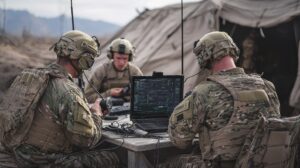
Pre-Deployment Considerations
The U.S. Army’s renewed emphasis on division-level operations has placed unprecedented demands on On-the-Move (OTM) communications. Division Areas of Operations often span 30–50 kilometers in width and depth, encompass 10,000–20,000 Soldiers, and involve hundreds of vehicles operating across complex and contested terrain. In this environment, communications are not a support function. They are a decisive enabler of command and control (C2).
Signal planners must deliver mobile, resilient, and secure communications that function reliably despite rugged terrain, electronic warfare threats, and constant maneuver. Any disruption to the network directly degrades situational awareness, slows decision-making, and increases operational risk. Rajant’s Kinetic Mesh® technology is purpose-built to address these realities, delivering resilient wireless communications at the tactical edge where failure is not an option.
Historically, signal units have contended with environmental conditions, mobility constraints, and security requirements while relying on line-of-sight, single-channel radios that were never designed to support modern data, video, and sensor traffic. By contrast, Kinetic Mesh® extends high-bandwidth, low-latency networking to Soldiers, vehicles, unmanned systems, and fixed assets, supporting the data demands of Multi-Domain Operations (MDO).
However, deploying a mesh network is not simply a technical decision. Long-term success depends on understanding how the network will be maintained, adapted, and sustained over time—particularly in RF-contested environments where dust, humidity, temperature extremes, and kinetic activity can degrade performance. Early consideration of interoperability, policy alignment, and operational support helps set realistic expectations and ensures the network strengthens, rather than complicates, mission execution.
To ground these considerations in real-world experience, Ed Preston, President of Military and Government Markets at Rajant, shares insights drawn from operational deployments of Kinetic Mesh® in active military environments.
Planning Efficient Network Topology
Reliable tactical communications begin with deliberate network design. Effective BreadCrumb® node planning ensures consistent performance even as maneuver elements disperse, converge, or operate in complex terrain. Planners must account for the number and type of connected assets: manned platforms, unmanned aerial systems (UAS), unmanned ground vehicles (UGV), sensors, and command posts, and design sufficient redundancy and bandwidth to sustain mission-critical traffic.
As operations evolve, so do networking requirements. Rajant’s BreadCrumb® nodes are designed to scale rapidly, enabling units to add, remove, or reposition nodes with minimal configuration. Using BC|Commander Suite, operators gain real-time visibility into network health while maintaining the flexibility required for fast-moving operations.
At the protocol level, InstaMesh® continuously evaluates link quality and dynamically routes traffic along the most efficient path. Unlike centralized architectures, InstaMesh® eliminates single points of failure, reducing latency and preserving communications even as nodes move or drop out of the network.
Terrain and infrastructure often present the greatest challenges. Urban environments, subterranean spaces, dense vegetation, and rugged terrain can disrupt traditional radio systems. Kinetic Mesh® mitigates these risks by naturally supporting Primary, Alternate, Contingency, and Emergency (PACE) communications. When a link degrades or fails, traffic is automatically rerouted, preserving freedom of maneuver and operational tempo without operator intervention.
Security in Contested Environments
In tactical operations, even minor security vulnerabilities can have disproportionate consequences. Any wireless solution introduced into military networks must address encryption, authentication, and trust-at-scale.
Rajant’s approach to security is embedded directly into the mesh architecture. BreadCrumb® nodes support strong cryptographic protections, including MAC address encryption and per-packet authentication, ensuring that only authorized devices can participate in the network. Because InstaMesh® operates locally at each node and does not store end-to-end routes, it minimizes exploitable attack surfaces and reduces the risk of interception or network mapping.
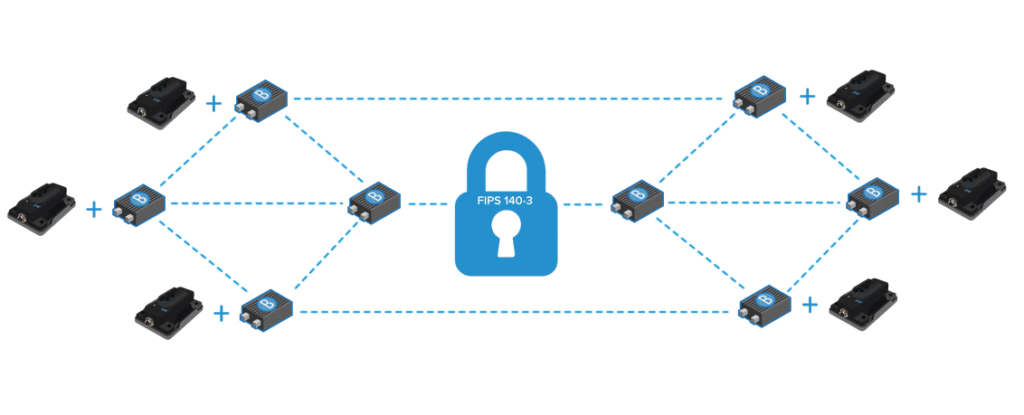
The DX5 series, Rajant’s smallest and lightest BreadCrumb®, has become a common choice for defense applications where Size, Weight, and Power (SWaP) constraints are critical. Its security features and mobility make it well-suited for dismounted operations, unmanned platforms, and rapidly deployable assets.
Per-packet authentication is particularly valuable in dynamic environments, continuously validating traffic as conditions change. This ensures network integrity without sacrificing performance, allowing commanders to trust the data flowing across the battlefield.
Interoperability with Existing Communications
As division-level operations grow more complex, interoperability is no longer optional. Tactical networks must integrate seamlessly with SATCOM, legacy radios, mmWave links, and emerging systems to enable unified operations across domains.
Kinetic Mesh® is designed to complement, not replace, existing communications. Rajant’s EdgeCrumb, powered by Cowbell OS, brings distributed computing to the tactical edge, enabling data exchange and processing across heterogeneous networks. This allows legacy systems to benefit from mesh resiliency while supporting the Army’s broader modernization objectives.
Effective modernization depends on bridging today’s capabilities with tomorrow’s technologies. Rajant’s proven ability to integrate third-party communications ensures that modernization efforts enhance operational effectiveness without disrupting established workflows.
Training and Operations: How Users (Soldiers/Operators) Interact with Mesh Systems
Technology only delivers value when Soldiers can use it effectively. One of Kinetic Mesh®’s key advantages is its operator-friendly design. Because the network automatically optimizes frequencies and routes traffic, configuration requirements are minimal.
BC|Commander Suite provides intuitive network management, reducing operator workload and minimizing human error. Rather than constantly adjusting settings, operators receive actionable alerts only when intervention is required, allowing them to focus on the mission.
This ease of use is not theoretical. During Operation Iraqi Freedom, Rajant mesh networks were introduced as frequencies were reclaimed by host-nation authorities. The solution was selected for its reliability, minimal training burden, and rapid integration into existing infrastructure. Soldiers were able to operate effectively with little disruption, benefiting from real-time video, low-latency data, and improved convoy coordination, directly enhancing C2 and force protection.
Key Takeaways
Reliable communications remain foundational to modern military operations. Kinetic Mesh® addresses the realities of contested, mobile environments by delivering secure, resilient networking at the tactical edge.
Key considerations for defense agencies include:
- Security as a prerequisite for mission-critical communications.
- The role of InstaMesh® in enabling scalable, OTM networks without single points of failure.
- Proven operational value in enhancing situational awareness, C2, and decision-making speed.
For further discussion on how Kinetic Mesh® can support defense operations, connect with Ed Preston on LinkedIn. If you’re interested in learning more about Rajant’s intelligent edge solutions and how Kinetic Mesh® can be effective for your defense operations, visit our contact page to connect with a Rajant Representative.
