

Traditional Port Connectivity Limitations
Ninety percent of all cargo is transported through ports — and the need to improve productivity without sacrificing safety has never been more critical. Ports around the world have invested in different types of technology and applications to achieve this objective. All of which need a reliable and scalable wireless network foundation to ensure there is clear and constant visibility on where containers are as they are handled by various moving assets such as STS, RTG, reach stackers, and trucks.
A wireless network that relies heavily on fixed infrastructure may have worked 5 years ago; however, technology needs of today and tomorrow require an intelligent self-healing wireless network that turns every moving asset into a network node. This blog will explore our BreadCrumb technology and how it integrates and works within port environments.
With experience in wireless networking and industrial communications, Sagar Chandra at Rajant Corporation brings an understanding of the challenges facing today’s connected port environments. In this blog, Sagar shares expert perspectives on how advanced port wireless communications and asset-based mesh networking are transforming the way ports operate, enabling greater agility, uptime, and real-time data flow.
Concept: Asset-Based Mesh
A view of any container port terminal reveals an environment with a mobile fleet and a container stack that is constantly in motion. At its core, Rajant’s Kinetic Mesh network is designed for exactly this type of environment: designed to convert all the moving RTGs, reach stackers, and trucks to function as a repeater offering better coverage and machine-to-machine connectivity. Now, a port has wireless communication anywhere there is a high mast or anywhere equipment is working.
Deployment Scenarios and Architecture
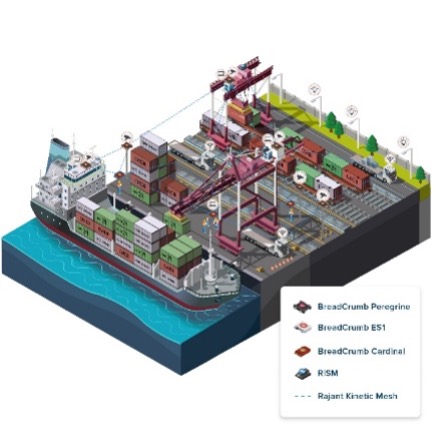
The figure above illustrates various BreadCrumb nodes and their interactions within Rajant’s Kinetic Mesh. Surveillance, smart lighting, laptops, and any other moving assets can be connected directly into the Industrial Internet of Things (IIoT) that is Rajant’s Kinetic Mesh, featuring low latency and near-zero downtime.
Benefits
Higher availability, ease-of-use, and scalability translate into faster ROI for the port customer. Rajant’s Kinetic Mesh network can offer these benefits as every node in the terminal functions as a repeater, a client, and an AP; a 3-in-1 solution. In addition, since we are designed to work around interferences – such as containers blocking line-of-sight connections or a messy RF environment – the Rajant network intelligently re-routes data automatically to reach its destination, thus ensuring the right decisions can be made in real-time.
Case Example
To show how these concepts translate into measurable results, this case study examines a real-world deployment of Rajant’s asset-based mesh networking in a major port operation. The site faced several challenges, including dense traffic, mobile assets, and the need for continuous, high-speed communication across large areas. By implementing Rajant’s Kinetic Mesh® network and optimizing port configurations, the port achieved reliable, low-latency wireless communication between cranes, vehicles, and control centers. The result was improved visibility, greater operational efficiency, and a network resilient enough to keep pace with daily port demands.
Read the full case study to see how Rajant’s mesh technology delivered real-world improvements in uptime, throughput, and scalability — and how similar strategies can strengthen your port operations.
If you’d like to learn more or discuss how these solutions can support your port’s wireless communication goals, reach out to a Rajant representative — or connect with Sagar directly on LinkedIn to continue the conversation.
